
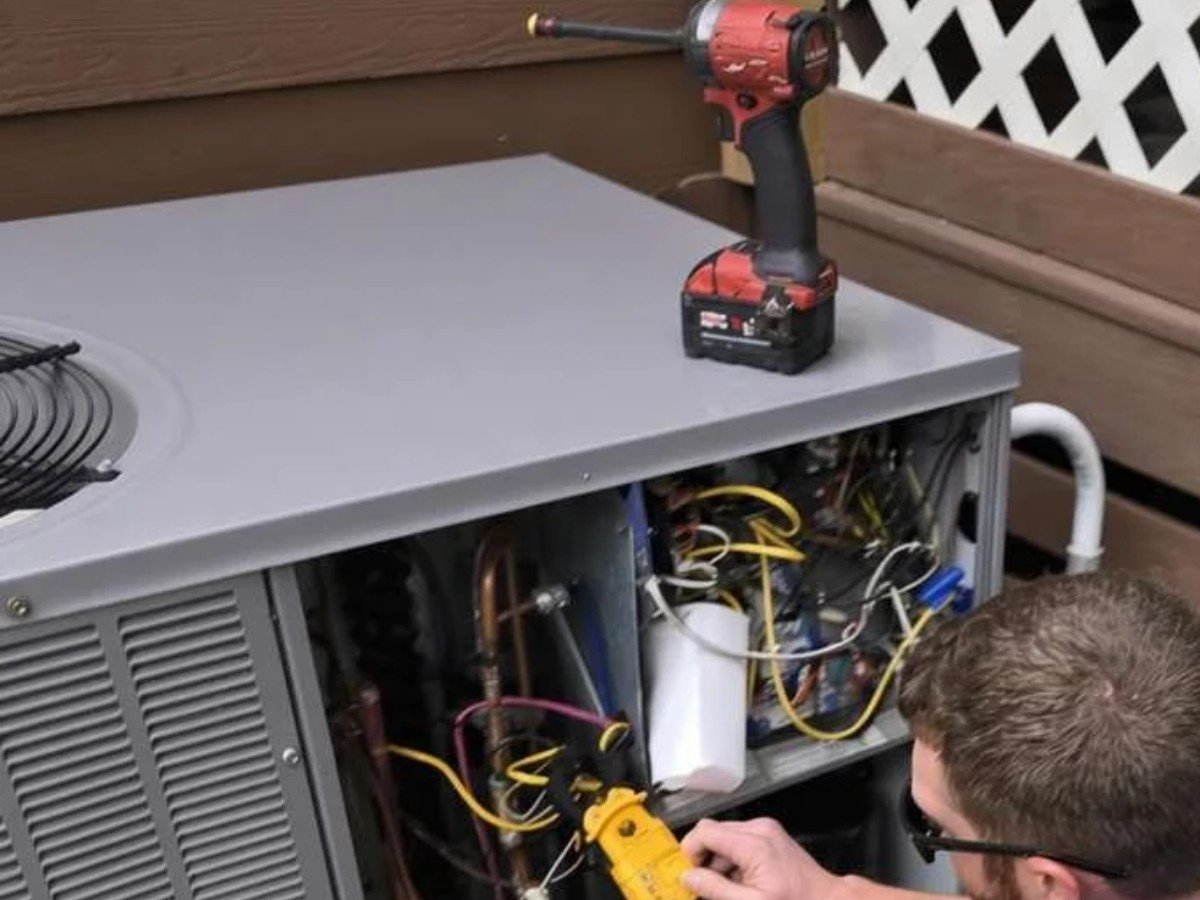
Is emergency heat expensive? Yes, it costs more, because EM heat runs your electric heat strips without any help from the heat pump. Heat pump emergency heat is different from aux heat: you switch it on yourself, and it runs the whole house on the strips alone. Use EM heat only when the heat pump has stopped working, then call for a repair.
The first real cold night of the year is when most people in St. Augustine and Jacksonville notice a new word on the thermostat. AUX. Or EM HEAT. Then the power bill shows up. Here’s what each setting means, what heat strips cost to run on JEA’s current rates, and when it’s time to call.
What’s the difference between aux heat and heat pump emergency heat?
Auxiliary heat (aux heat) is automatic. Your thermostat brings in the heat strips as a helper when the heat pump alone can’t hold your set temperature. Emergency heat is manual. You choose it, and it shuts the heat pump out and runs only the strips. Same strips, different reason.
Think of it like this:
- Heat pump: your main heat. It moves heat from the outside air into the house. That’s why it’s the efficient way to heat.
- Aux heat (heat pump auxiliary heat): the backup that tags in when it’s needed. You don’t touch it.
- EM heat: strips only, by your choice. It’s for when the heat pump has failed and you’re waiting on a fix.
Some homes use a gas furnace as the backup instead. This post covers the all-electric setup with heat strips. Heat strips cost more to run than the heat pump alone. If aux heat runs a lot, have a pro make sure the unit is working right.
When does aux heat on your thermostat kick on?
Aux heat on your thermostat usually turns on in three spots: when it’s cold enough outside that the heat pump falls behind, when you bump the thermostat up several degrees at once, and during a defrost cycle. Seeing AUX for a few minutes on a cold morning is normal. Seeing it for hours isn’t.
- A cold snap. As the outdoor temperature drops, the heat pump has less heat to pull from the air. The strips fill the gap.
- A big jump on the thermostat. Going from 66 to 72 in one shot can call the strips in. Raise the thermostat a degree or two at a time so the electric heat stays off.
- Defrost. On a cold, damp night the outdoor coil can frost up. The unit briefly flips to reverse to melt it. That usually takes just a few minutes, and the strips may run so you don’t feel cold air in the meantime.
If you’re seeing your heat pump blow cold air, we wrote a whole guide on why a heat pump blows cold air in winter.
When should you use heat pump emergency heat?
Use emergency heat when your heat pump has actually stopped heating. Think of an outdoor unit that won’t run, a tripped breaker on the outside unit that keeps tripping, or a unit iced solid that won’t clear. Flip to EM HEAT to stay warm, then call for repair. Don’t leave it on as a daily setting.
Here’s why. On emergency heat, every bit of warmth comes from the strips. Running strips only gives up the heat pump’s savings.
Not a good reason: “It feels warmer.” Strips do blow hotter air. They also cost more every hour they run.
How much does emergency heat cost to run in Jacksonville?
Heat strips use about as much electricity per hour as their size in kilowatts. So a 10 kW strip running a full hour uses about 10 kWh. On JEA‘s residential rate effective October 1, 2026, that’s about $1.28 an hour on the first 1,000 kWh you use in a month and about $1.47 an hour after that.
| Heat strip size | Cost per hour (first 1,000 kWh) | Cost per hour (over 1,000 kWh) | 8-hour cold night (over 1,000 kWh) |
|---|---|---|---|
| 5 kW | $0.64 | $0.73 | $5.87 |
| 10 kW | Heat strip size | Cost per hour (first 1,000 kWh) | Cost per hour (over 1,000 kWh) | 8-hour cold night (over 1,000 kWh) | —|—|—|—| 5 kW | $0.64 | $0.73 | $5.87 | 10 kW | $1.28 | $1.47 | $11.74 | 15 kW | $1.92 | $2.20 | $17.62 | 20 kW | $2.56 | $2.94 | $23.49 | .28 | Heat strip size | Cost per hour (first 1,000 kWh) | Cost per hour (over 1,000 kWh) | 8-hour cold night (over 1,000 kWh) | —|—|—|—| 5 kW | $0.64 | $0.73 | $5.87 | 10 kW | $1.28 | $1.47 | $11.74 | 15 kW | $1.92 | $2.20 | $17.62 | 20 kW | $2.56 | $2.94 | $23.49 | .47 | Heat strip size | Cost per hour (first 1,000 kWh) | Cost per hour (over 1,000 kWh) | 8-hour cold night (over 1,000 kWh) | —|—|—|—| 5 kW | $0.64 | $0.73 | $5.87 | 10 kW | $1.28 | $1.47 | $11.74 | 15 kW | $1.92 | $2.20 | $17.62 | 20 kW | $2.56 | $2.94 | $23.49 | 1.74 |
| 15 kW | Heat strip size | Cost per hour (first 1,000 kWh) | Cost per hour (over 1,000 kWh) | 8-hour cold night (over 1,000 kWh) | —|—|—|—| 5 kW | $0.64 | $0.73 | $5.87 | 10 kW | $1.28 | $1.47 | $11.74 | 15 kW | $1.92 | $2.20 | $17.62 | 20 kW | $2.56 | $2.94 | $23.49 | .92 | How we got these numbers: strip size (kW) x hours x JEA’s total residential rate per kWh. JEA lists $0.12790 per kWh for the first 1,000 kWh and $0.14680 above that, energy plus fuel, effective October 1, 2026. That’s before JEA’s $21.00 basic monthly charge and local taxes and fees. The 8-hour column assumes the strips run nonstop, which is the worst case. On aux, strips usually cycle on and off..20 | Heat strip size | Cost per hour (first 1,000 kWh) | Cost per hour (over 1,000 kWh) | 8-hour cold night (over 1,000 kWh) | —|—|—|—| 5 kW | $0.64 | $0.73 | $5.87 | 10 kW | $1.28 | $1.47 | $11.74 | 15 kW | $1.92 | $2.20 | $17.62 | 20 kW | $2.56 | $2.94 | $23.49 | 7.62 |
| 20 kW | How we got these numbers: strip size (kW) x hours x JEA’s total residential rate per kWh. JEA lists $0.12790 per kWh for the first 1,000 kWh and $0.14680 above that, energy plus fuel, effective October 1, 2026. That’s before JEA’s $21.00 basic monthly charge and local taxes and fees. The 8-hour column assumes the strips run nonstop, which is the worst case. On aux, strips usually cycle on and off..56 | How we got these numbers: strip size (kW) x hours x JEA’s total residential rate per kWh. JEA lists $0.12790 per kWh for the first 1,000 kWh and $0.14680 above that, energy plus fuel, effective October 1, 2026. That’s before JEA’s $21.00 basic monthly charge and local taxes and fees. The 8-hour column assumes the strips run nonstop, which is the worst case. On aux, strips usually cycle on and off..94 | How we got these numbers: strip size (kW) x hours x JEA’s total residential rate per kWh. JEA lists $0.12790 per kWh for the first 1,000 kWh and $0.14680 above that, energy plus fuel, effective October 1, 2026. That’s before JEA’s $21.00 basic monthly charge and local taxes and fees. The 8-hour column assumes the strips run nonstop, which is the worst case. On aux, strips usually cycle on and off.3.49 |
How we got these numbers: strip size (kW) x hours x JEA’s total residential rate per kWh. JEA lists $0.12790 per kWh for the first 1,000 kWh and $0.14680 above that, energy plus fuel, effective October 1, 2026. That’s before JEA’s How we got these numbers: strip size (kW) x hours x JEA’s total residential rate per kWh. JEA lists $0.12790 per kWh for the first 1,000 kWh and $0.14680 above that, energy plus fuel, effective October 1, 2026. That’s before JEA’s $21.00 basic monthly charge and local taxes and fees. The 8-hour column assumes the strips run nonstop, which is the worst case. On aux, strips usually cycle on and off.1.00 basic monthly charge and local taxes and fees. The 8-hour column assumes the strips run nonstop, which is the worst case. On aux, strips usually cycle on and off.
Not on JEA? The math is the same with any utility. Take the kW on your strip’s label, multiply by hours, then multiply by the per-kWh rate on your bill.
Don’t know what size heat pump strips you have? It’s on the air handler’s label, and we can check it on a visit. If your strips or heat pump need work, each repair is quoted for your system before any work starts.
How cold does it get in Jacksonville and St. Augustine?
Cold enough that aux heat earns its keep. Per NOAA’s 1991-2020 climate normals for Jacksonville International Airport, the normal low is about 46 degrees in December and 43 in January.
Two local things to know:
- Our cold comes in snaps. Most of the winter is mild, so the heat pump coasts. Then a front drops temps overnight and the strips kick on all at once.
- The first cold night shows problems. Your heat pump spends most of the year cooling. A problem in heating mode often doesn’t show up until that first chilly night.
On December 31, 2025, Jacksonville’s low hit 30 degrees, per NOAA’s daily climate data for Jacksonville International Airport. That’s a strip-heat night.
When should you call for heat pump repair?
Call when AUX stays on for hours on a mild night, when the outdoor unit won’t run, when ice won’t clear, or when your bill jumps and the house still feels cool. Those point to a heat pump that’s failing and leaning on auxiliary heat to cover for it.
Signs it’s time:
- AUX is on most of the day, even in the 50s.
- The outdoor fan or compressor isn’t running.
- Ice covers the whole outdoor coil and stays.
- A burning smell that doesn’t fade (a quick dusty smell the first time you run the heat is common).
- Your power bill spikes with no change in how you use the house.
Wright Brothers Heating & Air is veteran- and family-owned, and we’re a Florida Certified Air Conditioning Contractor (CAC1824035). We repair heat pumps, AC and mini splits across St. Augustine and St. Johns, Clay and Duval counties, including Jacksonville. Our techs carry common parts on the truck, so most repairs are done in one visit. See our heat pump and heating repair service.
Need it looked at? Call (904) 837-0306 or request service online.
How do you keep heat strips from running all winter?
Keep the strips off by keeping the heat pump healthy and the thermostat steady. Set it and leave it, change filters, keep the outdoor unit clear, and get a fall heating check before the first cold night. A heat pump in good shape handles most Northeast Florida nights with little help.
- Don’t make big jumps. Move the thermostat a degree or two at a time.
- Skip deep setbacks. Keep the temperature steady.
- Change the filter. A clogged filter makes the heat pump work harder.
- Clear the outdoor unit. Keep leaves, mulch and plants away from it.
- Get a fall check. Our Premier Maintenance Plan includes a spring AC tune-up and a fall heat pump and heating check. Here’s whether a maintenance plan is worth it in St. Augustine.
Need it fixed? See our heating repair service in St. Augustine or our heat pump repair page.
FAQ
Is it bad to run emergency heat on a heat pump?
It’s not an everyday setting because it costs more. Emergency heat runs only the electric strips, and those cost more to run than the heat pump. Use it as a short-term backup when the heat pump isn’t working, then get the heat pump fixed.
What does aux heat mean on my thermostat?
AUX means your heat strips are helping the heat pump. That’s normal on cold mornings, after a big thermostat bump, or during defrost. If AUX stays on for hours on a mild day, have the system checked.
What’s the difference between auxiliary heat and emergency heat?
Auxiliary heat turns on automatically to help the heat pump. Emergency heat is a setting you choose that shuts the heat pump out and runs the strips only.
How long does a heat pump defrost cycle last?
Defrost usually just takes a few minutes. The strips may run during defrost so you don’t get a blast of cool air.
What areas does Wright Brothers serve?
St. Augustine and St. Johns, Clay and Duval counties, including Jacksonville, Jacksonville Beach, Ponte Vedra Beach, Nocatee and World Golf Village.
Does Wright Brothers repair heat pumps?
Yes. We repair heat pumps, AC systems and mini splits, and our techs carry common parts on the truck so most repairs are done in one visit.
Leave a Reply