
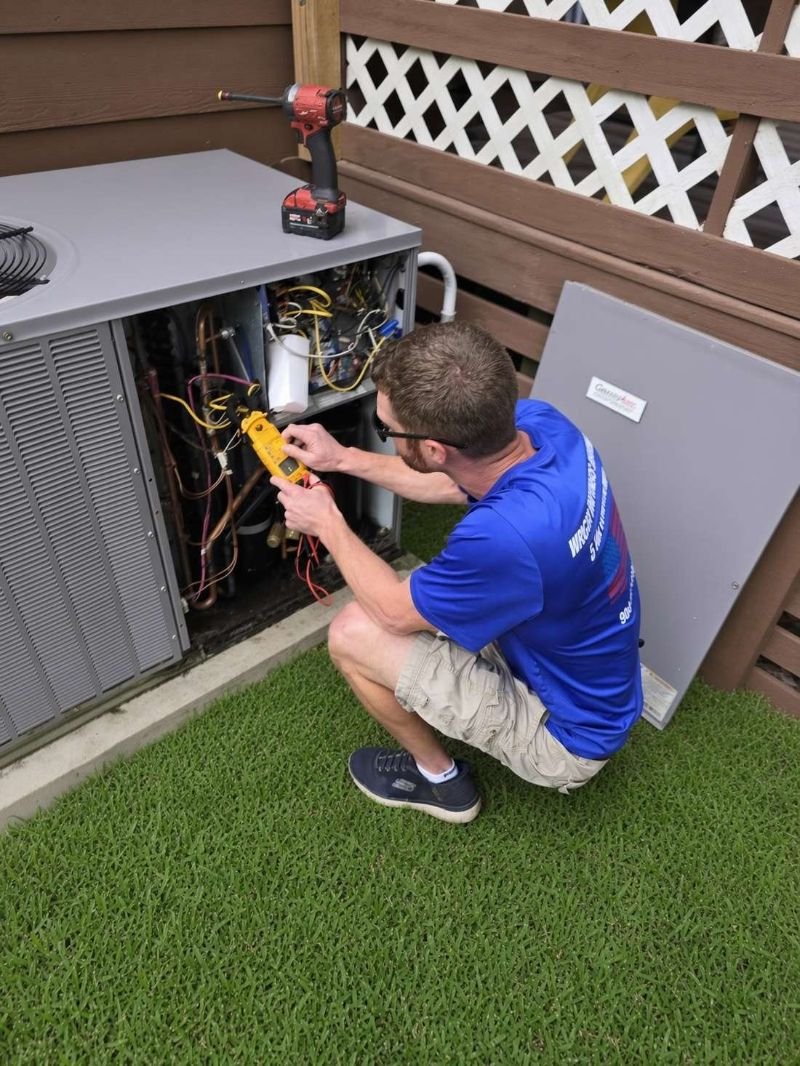
A heat pump frozen under a thin layer of frost, with steam rising off the coil, is normal defrost. A heat pump is an air conditioner that can run in reverse, which is why it can ice up in winter the way an AC coil can ice up in summer. The system clears itself in minutes. A heat pump frozen solid, with ice that stays for hours, is not normal. That calls for a technician, not a wait-and-see approach.
Heat Pump Frozen in Winter? What Normal Defrost Mode Looks Like
Yes, most of the time. Here’s what normal defrost looks like from your yard:
- Light frost across the outdoor coil
- A cloud of steam rising off the unit
- A whooshing sound as the system switches modes
- The outdoor fan stopping for a few minutes
- AUX or EH lit up on your thermostat
None of this means your system is failing. It’s heat pump defrost mode doing its job. In defrost mode, the reversing valve flips the system briefly so warm refrigerant runs through the outdoor coil and melts the frost. That shift is the whoosh you hear. Your aux heat may come on at the same time so the house doesn’t cool off.
Most systems check for frost every 30 to 90 minutes and run a defrost cycle for 5 to 15 minutes, according to Lennox. Trane says its own defrost cycles usually last 3 to 5 minutes. Either way, defrost mode should clear the frost once the cycle finishes. You don’t need to do anything while it runs. Stay inside and let the system work.
Why Does a Heat Pump Freeze on Damp Northeast Florida Nights?
Your heat pump’s outdoor coil runs 10 to 20 degrees colder than the air around it, according to Trane. That’s enough for frost to form even when the air is above freezing. Defrost mode can start once outdoor temperatures drop into the low 40s.
Northeast Florida gets cold enough for this most winters. NOAA’s 1991-2020 climate normals for Jacksonville International Airport put the normal low at 45.8°F in December and 42.9°F in January. The same data shows about 3.6 days at or below 32°F in December and 6.2 in January. And because the coil runs colder than the air, frost can show up on damp nights that never hit freezing.
Add damp coastal air into that mix, and frost on your coil on a cold, damp night isn’t a sign your system is broken. It’s just physics. Cold metal pulls moisture out of humid air, and that moisture turns to ice on contact. If you step outside on a cold, damp night and see frost or a steam cloud around the unit, that’s your system working as designed.
Normal Frost vs. a Real Freeze-Up
Heat pumps ice up for different reasons. Use this list to tell the two apart in under a minute.
Normal defrost:
- Light, even frost on the coil
- A steam cloud while the cycle runs
- The cycle finishes within 15 minutes
- The outdoor fan starts back up afterward
- AUX clears once defrost ends
Real freeze-up:
- Thick, solid ice across the coil
- Ice coating the top or sides of the unit
- Ice still there after a full defrost cycle
- The outdoor fan stays stopped
- AUX stays lit for hours
- Little or no warm air at your registers (see why a heat pump blows cold air)
If you see anything from the second list, treat it as a real problem. Don’t wait it out.
What Can You Safely Check Yourself?
A few quick checks take less than five minutes and cost you nothing:
- Set the thermostat to HEAT and leave it there.
- Pull the filter. If it’s dirty or gray with dust, swap it.
- Check that supply vents are open and return grilles aren’t blocked by furniture or rugs.
- Give the outdoor unit at least two feet of clearance on every side, per Lennox. Clear away leaves, mulch, and plants pressed against the cabinet. Tight clearance chokes airflow across the coil, and poor airflow is part of what starts a freeze-up.
- Make sure meltwater from the unit isn’t refreezing across a walkway or driveway.
- If a breaker tripped, reset it once. If it trips again, stop and call.
What not to do:
- Don’t chip, scrape, or hose ice off the coil.
- Don’t cover the unit.
- Don’t open panels or touch refrigerant lines.
High-voltage parts and refrigerant lines inside the cabinet aren’t safe to handle without training.
If a frozen heat pump has your house getting cold, switch to emergency heat to stay warm while you call for repair.
Ice that won’t clear? Let’s take a look.
Send a quick message and we’ll get right back to you, or call (904) 837-0306.
What Causes a Heat Pump to Freeze Up?
Heat pumps don’t freeze up for no reason. A handful of mechanical problems cause a real freeze-up, according to Lennox:
- Dirty or blocked coils
- Faulty defrost sensors or controls
- Low refrigerant
Indoor problems matter too. A clogged filter or blocked returns cut airflow across the indoor evaporator coil, and that strains the whole system. When the outdoor fan won’t spin or defrost mode never kicks in, a frozen heat pump can’t shed its ice on its own. Every one of these needs a technician to diagnose correctly. Guessing at home usually just delays the fix.
When Should You Call for Heat Pump Repair?
Call when you see any of these:
- Ice stays on the unit after a defrost cycle finishes
- The whole coil or the top of the unit is iced over
- Defrost cycles run constantly or keep getting longer, a sign the system is struggling, according to Trane and Lennox
- The outdoor fan isn’t spinning
- AUX or EH stays lit for hours
Wright Brothers Heating & Air Conditioning is veteran- and family-owned. We hold Florida Certified Air Conditioning Contractor license CAC1824035. Our techs carry common parts on the truck, so most repairs finish in a single visit instead of a second trip for a part. We serve St. Augustine and St. Johns, Clay, and Duval counties. Call (904) 837-0306 and tell us what you’re seeing.
Learn more about our heat pump and HVAC repair, including service in Jacksonville.
How Do You Keep It From Freezing Again?
Three habits help keep freeze-ups away:
- Change your filter on schedule, so airflow across the indoor coil stays steady.
- Keep two feet of clearance around the outdoor unit, year-round, not just in winter.
- Get your heat pump and heating system checked every fall, before the first cold snap arrives.
That fall check is included in the Premier Maintenance Plan.
Need it fixed? See our heating repair service in St. Augustine or our heat pump repair page.
FAQ
Is it normal for a heat pump to freeze in winter?
Light frost on the outdoor coil is normal. Your system runs a defrost cycle to clear it automatically. Thick ice that stays after a defrost cycle finishes is not normal and needs a technician.
How long does a heat pump defrost cycle last?
Most systems check for frost every 30 to 90 minutes and run a defrost cycle for 5 to 15 minutes, according to Lennox. Trane says its own cycles usually last 3 to 5 minutes.
Why is steam coming out of my heat pump?
That steam cloud is part of normal defrost. The system briefly reverses to melt frost off the outdoor coil, and the melting ice creates visible steam. It should clear once the cycle finishes.
Can I pour water on a frozen heat pump?
No. Let the defrost cycle run on its own. If ice stays after the cycle finishes, call for repair instead of trying to clear it yourself.
What should I do if my heat pump freezes and won’t defrost?
Check that the thermostat is on HEAT, the filter is clean and the outdoor unit has two feet of clearance. Don’t chip or hose off the ice. If the outdoor coil is still iced after a defrost cycle, call (904) 837-0306 for heat pump repair.
What areas does Wright Brothers serve?
Wright Brothers Heating & Air Conditioning serves St. Augustine and St. Johns, Clay, and Duval counties in Northeast Florida.
Leave a Reply